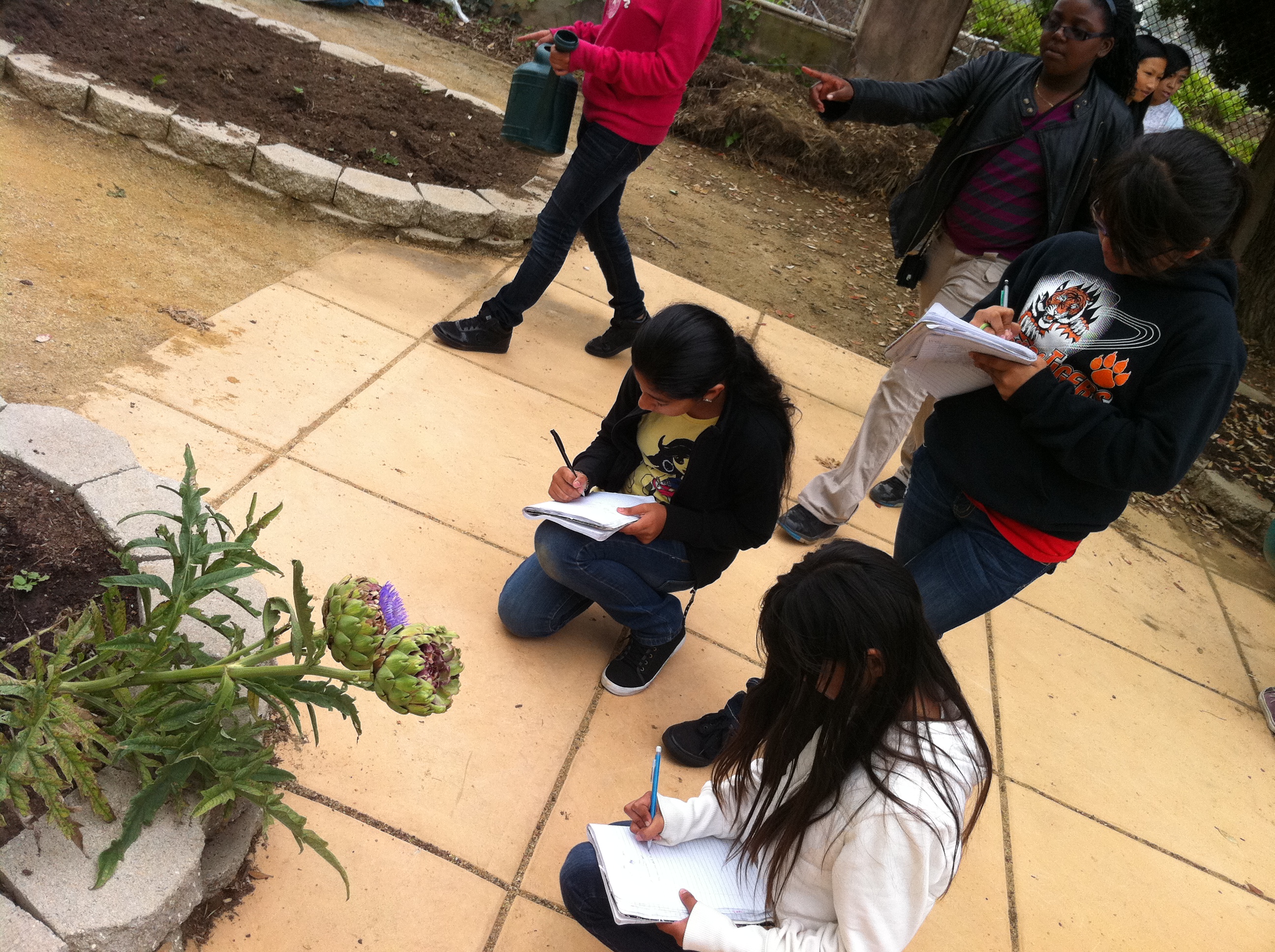
As many of you already know, garden education is amazing. Garden education brings students to start critically assessing their food, food systems, nutrition, health, and environment. Moreover, for students like me, it helps students have an experiential learning experience to better comprehend science curriculum. What I’ve found a great way to tie the garden with the classroom is having students create an ecological journal in their classroom. With an ecological journal students gather data, become more aware of their surroundings, and most importantly begin to ask questions on the natural processes that are happening in the garden.
When I spoke to a friend about implementing an ecological journal that we did in our college ecology class, in a middle school, my friend thought I was over my head. How are you going to get students to focus on something for so long, she asked? The reality is there will be some students that will have a hard time reflecting for 10 minutes. I found out that if I set the guidelines and have a clear structure these students just needed a little reminding. Some students actually do amazing and find it just a nice time to reflect in the garden and focusing on something so small, to see that there is something bigger.
The highlight so far is seeing students begin to question how things work. Why is one plant getting eaten more than others? How come a plant in one section of the garden is growing taller than the same plant on another side? Isn’t an artichoke a vegetable, but why is it a flower? Can I still eat the artichoke when its a flower? All these questions teachers are encouraging students to find ways to answer their questions and test out what they believe its happening. Some students on their own go home and look up what they’ve been curious about. The Ecological Journal is a great way to introduce the scientific method.
I personally feel that an ecological journal is great because students have 10 minutes to just reflect on something outside of them. Students begin to see that there is more going on in their everyday lives and there are tiny things that we ignore on our everyday lives. I encourage all garden educators and teachers to have students create an ecological journal and begin thinking of the larger world.


Speak Your Mind