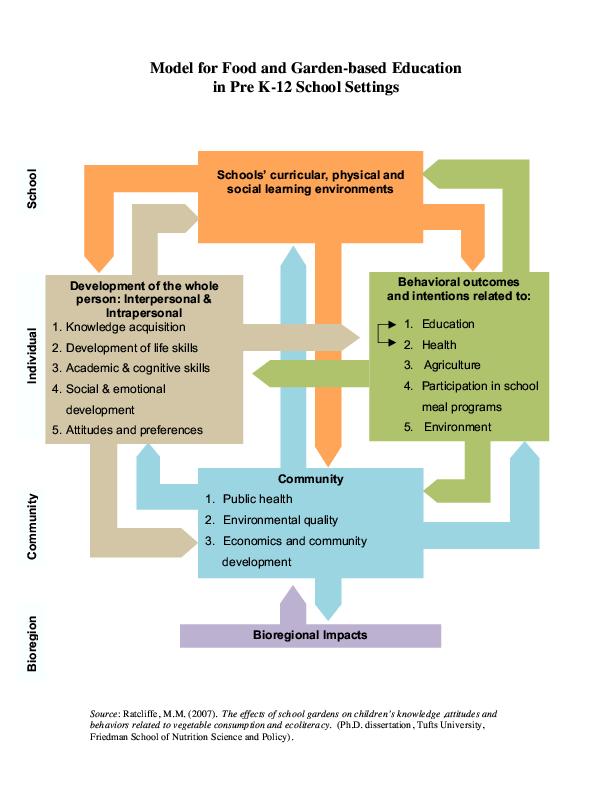
Urban Sprouts has field-tested and evaluated the Garden-based Education Model developed by Dr. Michelle Ratcliffe (Ratcliffe et al., 2006; Ratcliffe et al., 2009). This model combines the Social Cognitive Theory of behavior change (Bandura, 1986), youth development theory and ecoliteracy models to determine the quantity and quality of garden-based experiences that enable youth to improve their health and nutrition. Learning that takes place in an interactive and multi-sensory context—the school garden—helps youth retain new knowledge and attitudes in the long-term. Results from Urban Sprouts’ program evaluations show real changes in participating youths’ attitudes towards the environment, consumption of fruits and vegetables, and motivation to make change in their eating habits at school and at home. You can view this short presentation on the model and results.
Urban Sprouts is effective and innovative because our program model includes:
-
Behavior change.
Garden-based education engages youth and families in growing food from seed to harvest to table, helping them to make real changes in their eating habits and physical activity.
-
Meaningful Participation and Leadership.
Giving youth and their parents real leadership and the skills for community action greatly strengthens program outcomes;
-
Parent Involvement in Schools.
Parents are involved directly in the school garden, maintaining their own garden plots to increase family access to healthy food, sharing knowledge with teachers and students, and reinforcing their children’s new learning at home;
-
School-Community Partnerships.
We build collaboration between schools, students, parents, and community volunteers, to foster an environment at school, home and in the community that supports youths’ goals of healthy eating and increased physical activity.
Urban Sprouts’ program model enhances the learning environment in three ways.
First, the physical school garden teaches youth and their families how to build and maintain gardens and how to plant, tend, harvest, prepare and eat fresh produce through hands-on experience.
Second, curriculum teaches knowledge and critical-thinking about healthy food choices and the environment, through hands-on science experiments, interactive problem-solving activities, and reading and discussion assignments that provoke critical-thinking and debate.
Third, hands-on group project work in the garden builds participants’ emotional and social health, or resiliency assets, like confidence, responsibility, decision-making, empowerment, problem-solving, self-efficacy and cooperation. Strong resiliency assets further strengthen adoption of positive health behaviors, while giving participants the leadership skills to share learning and make change in their homes and communities.
Reaping Results
We have already begun to see how gardening has transformed the schools where we work. Each year, we conduct an in-depth evaluation of our programs, using our Garden-Based Education model to assess our results. Our evaluation tools include pre/ post surveys and focus group interviews with students, and individual interviews with school staff. Read more…
Download the published journal article on the impacts of school gardens – the study that led to the creation of Urban Sprouts! Also view our 5-Year Report illustrating our accomplishments since the beginning.
Training
At Urban Sprouts, we receive more phone calls and emails that we
can handle from teachers, parents, health educators, and
researchers asking for our help and advice. To meet this demand,
we plan to share our vision, methods, and results through a
program of training, coaching and interactive web-based tools.
Read more…